Mahatma Gandhi
Mahatma Gandhi was a Great freedom fighter.
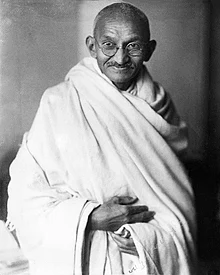
Here's a time line of Mohandas Karamchand Gandhi
- 1869-Mohandas Karamchand Gandhi was born on 2 October 1869 into an Indian Gujarati Hindu Modh Baniya family in Porbandar (also known as Sudamapuri), a coastal town on the Kathiawar Peninsula and then part of the small princely state of Porbandar in the Kathiawar Agency of the Indian Empire. His father, Karamchand Uttamchand Gandhi (1822–1885), served as the diwan (chief minister) of Porbandar state.
- 1874-Gandhi's father Karamchand left Porbandar for the smaller state of Rajkot, where he became a counsellor to its ruler, the Thakur Sahib; though Rajkot was a less prestigious state than Porbandar, the British regional political agency was located there, which gave the state's diwan a measure of security. In 1876, Karamchand became diwan of Rajkot and was succeeded as diwan of Porbandar by his brother Tulsidas. His family then rejoined him in Rajkot.
- 1883-the 13-year-old Mohandas was married to 14-year-old Kasturbai Makhanji Kapadia (her first name was usually shortened to "Kasturba", and affectionately to "Ba") in an arranged marriage, according to the custom of the region at that time. In the process, he lost a year at school, but was later allowed to make up by accelerating his studies.His wedding was a joint event, where his brother and cousin were also married. Recalling the day of their marriage, he once said, "As we didn't know much about marriage, for us it meant only wearing new clothes, eating sweets and playing with relatives." As was prevailing tradition, the adolescent bride was to spend much time at her parents' house, and away from her husband.
- 1885- Gandhi's father Karamchand died.Gandhi, then 16 years old, and his wife of age 17 had their first baby, who survived only a few days. The two deaths anguished Gandhi.The Gandhi couple had four more children, all sons: Harilal, born in 1888; Manilal, born in 1892; Ramdas, born in 1897; and Devdas, born in 1900.
- 1887-the 18-year-old Gandhi graduated from high school in Ahmedabad.In January 1888, he enrolled at Samaldas College in Bhavnagar State, then the sole degree-granting institution of higher education in the region. But he dropped out and returned to his family in Porbandar.
- 1888- Gandhi aged 18, left Porbandar for Mumbai, then known as Bombay. Upon arrival, he stayed with the local Modh Bania community while waiting for the ship travel arrangements. The head of the community knew Gandhi's father. After learning Gandhi's plans, he and other elders warned Gandhi that England would tempt him to compromise his religion, and eat and drink in Western ways. Gandhi informed them of his promise to his mother and her blessings. The local chief disregarded it, and excommunicated him from his caste. But Gandhi ignored this, and on 4 September, he sailed from Bombay to London. His brother saw him off. Gandhi attended University College, London which is a constituent college of University of London.
- 1906-when the British declared war against the Zulu Kingdom in Natal, Gandhi at age 36, sympathised with the Zulus and encouraged the Indian volunteers to help as an ambulance unit.He argued that Indians should participate in the war efforts to change attitudes and perceptions of the British people against the coloured people.Gandhi, a group of 20 Indians and black people of South Africa volunteered as a stretcher-bearer corps to treat wounded British soldiers and the opposite side of the war: Zulu victims.
Struggle for Indian independence (1915–1947)
- 1915 -Gandhi joined the Indian National Congress and was introduced to Indian issues, politics and the Indian people primarily by Gokhale. Gokhale was a key leader of the Congress Party best known for his restraint and moderation, and his insistence on working inside the system. Gandhi took Gokhale's liberal approach based on British Whiggish traditions and transformed it to make it look Indian.
- 1934 -Gandhi resigned from Congress party membership. He did not disagree with the party's position but felt that if he resigned, his popularity with Indians would cease to stifle the party's membership, which actually varied, including communists, socialists, trade unionists, students, religious conservatives, and those with pro-business convictions, and that these various voices would get a chance to make themselves heard. Gandhi also wanted to avoid being a target for Raj propaganda by leading a party that had temporarily accepted political accommodation with the Raj.
- 1944 -Gandhi's arrest lasted two years, as he was held in the Aga Khan Palace in Pune. During this period, his long time secretary Mahadev Desai died of a heart attack, his wife Kasturba died after 18 months' imprisonment on 22 February 1944; and Gandhi suffered a severe malaria attack.[162] While in jail, he agreed to an interview with Stuart Gelder, a British journalist. Gelder then composed and released an interview summary, cabled it to the mainstream press, that announced sudden concessions Gandhi was willing to make, comments that shocked his countrymen, the Congress workers and even Gandhi. The latter two claimed that it distorted what Gandhi actually said on a range of topics and falsely repudiated the Quit India movement.
Death
- 1948 At 5:17 pm on 30 January 1948, Gandhi was with his grandnieces in the garden of Birla House (now Gandhi Smriti), on his way to address a prayer meeting, when Nathuram Godse, a Hindu nationalist, fired three bullets into his chest from a pistol at close range. According to some accounts, Gandhi died instantly. In other accounts, such as one prepared by an eyewitness journalist, Gandhi was carried into the Birla House, into a bedroom. There he died about 30 minutes later as one of Gandhi's family members read verses from Hindu scriptures.
"If we could change ourselves, the tendencies in the world would also change. As a man changes his own nature, so does the attitude of the world change towards him. We need not wait to see what others do."
--Mahatma Gandhi